Railway networks are among the most extensive and critical transportation infrastructures in the world. With thousands of kilometers of tracks, bridges, tunnels, stations, and surrounding assets to monitor, maintaining railway safety requires continuous visibility into what is happening along the track.
Traditional railway inspection methods, including manual patrols and periodic inspections, remain important but may not provide continuous monitoring across long stretches of railway infrastructure. This is where Distributed Acoustic Sensing (DAS) is emerging as a powerful technology for railway track monitoring and infrastructure protection.
By transforming optical fiber into a continuous sensing system, DAS can detect and locate vibrations and acoustic events along extensive railway corridors. Research has demonstrated applications ranging from railway intrusion detection and activity monitoring to track-support condition monitoring.
What Is Distributed Acoustic Sensing?
Distributed Acoustic Sensing is a fiber-optic sensing technology that uses an optical fiber cable as a continuous line of vibration sensors.
Instead of installing individual sensors at multiple locations, DAS interrogates the optical fiber and analyzes changes in the light travelling through it. Vibrations caused by trains, people, animals, excavation, falling objects, or other activities can produce detectable changes in the fiber signal.
This allows a single DAS system to monitor a long section of railway infrastructure continuously.
Modern DAS systems can provide information about:
- Where an event has occurred
- When the event occurred
- The characteristics of the detected vibration
- Whether the event resembles a known activity or threat
This makes DAS particularly suitable for large railway networks where installing and maintaining thousands of conventional sensors can be challenging.
Why Railway Safety Needs Continuous Monitoring
Railway tracks are exposed to a wide range of potential hazards. These may originate from the track itself, the surrounding environment, or unauthorized activities near the railway corridor.
Potential threats and events include:
- Unauthorized personnel entering railway corridors
- Animals approaching or entering tracks
- Digging or excavation near railway infrastructure
- Falling rocks and debris
- Trackside construction activities
- Abnormal train or wheel-related vibrations
- Infrastructure disturbances
- Track-support problems
- Tampering or vandalism
- Environmental and seismic activity
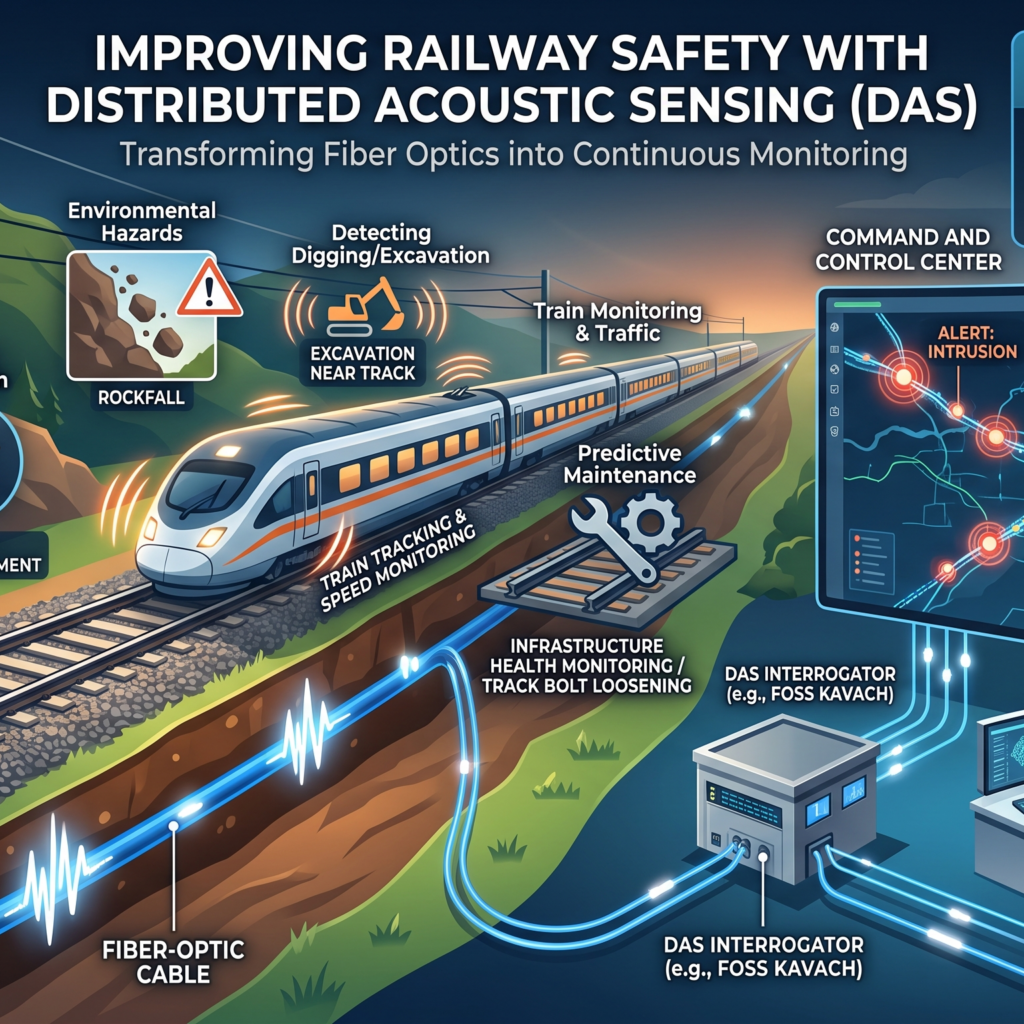
Research conducted using DAS along railway tracks has demonstrated the ability to capture signatures associated with activities such as walking, digging, falling rocks, and animal movement.
The ability to continuously monitor these activities can help railway operators move from a primarily reactive approach toward a more proactive safety strategy.
How DAS Improves Railway Safety
1. Real-Time Railway Track Monitoring
One of the biggest advantages of DAS is its ability to provide continuous monitoring along long sections of railway infrastructure.
Instead of relying only on periodic inspections, railway operators can receive information about unusual vibration events as they occur.
This can help identify potential hazards earlier and enable railway personnel to investigate the affected location.
DAS has also been investigated for railway traffic monitoring, including the detection and tracking of trains and other vehicles near railway corridors.
2. Railway Intrusion Detection
Unauthorized access to railway tracks can create serious safety risks.
A person entering a restricted railway area, climbing a fence, digging near the track, or carrying out other activities may generate characteristic vibration patterns.
A fiber-optic DAS system can detect these disturbances and determine their approximate location along the sensing fiber.
This provides railway security teams with an additional layer of situational awareness and can help them respond more quickly to potential intrusion events.
3. Wildlife Detection Near Railway Tracks
Wildlife-train collisions are a significant concern in areas where railway corridors pass through forests or wildlife habitats.
DAS can detect vibrations generated by animal movement near the railway corridor. Research has specifically examined the use of fiber-optic DAS for identifying animal-related activity along railway tracks.
This capability can support early-warning systems in wildlife-sensitive railway zones, potentially allowing railway authorities to take appropriate precautionary measures.
4. Detecting Environmental Hazards
Railway infrastructure can be affected by environmental events such as:
- Rockfalls
- Falling debris
- Ground movement
- Construction activity
- Other abnormal vibrations
DAS can continuously monitor the surrounding area and detect unusual vibration signatures.
This is particularly valuable in mountainous regions, tunnels, embankments, and other areas where environmental conditions can change rapidly.
5. Supporting Predictive Maintenance
Railway safety is not only about detecting intruders or external threats. The condition of the railway infrastructure itself is equally important.
Researchers are investigating DAS and other distributed optical-fiber sensing technologies for monitoring track-support conditions and identifying changes that may require maintenance.
DAS has also been investigated for applications such as monitoring railway track bolt loosening, demonstrating its potential for infrastructure-condition monitoring.
When combined with historical monitoring data, continuous sensing can contribute to a more predictive maintenance strategy by helping maintenance teams identify unusual patterns before they develop into larger operational problems.
DAS vs Traditional Railway Monitoring
Traditional railway monitoring technologies remain essential, but they often depend on discrete sensors, cameras, inspection teams, or equipment installed at specific locations.
DAS offers a fundamentally different approach.
| Feature | Conventional Sensors | Distributed Acoustic Sensing |
| Monitoring method | Point-based | Distributed along fiber |
| Coverage | Limited to sensor locations | Long continuous sections |
| Sensor installation | Multiple sensors may be required | Optical fiber acts as sensing medium |
| Real-time monitoring | Depends on system | Yes |
| Event localization | Sensor-dependent | Along sensing fiber |
| Remote monitoring | Possible | Yes |
| Long-distance applications | Can require many devices | Well suited |
| Maintenance | Multiple field devices | Centralized interrogator + fiber infrastructure |
The key advantage is not necessarily that DAS replaces every existing railway safety technology. Instead, it can complement existing railway signaling, CCTV, inspection, and monitoring systems by providing an additional layer of continuous vibration-based information.
Why Fiber Optics Are Suitable for Railway Applications
Optical fiber provides several characteristics that make it attractive for railway monitoring.
The sensing fiber contains no electrical sensing elements along the monitored route. This allows the sensing infrastructure to be deployed over long distances while keeping the active interrogation equipment centralized.
Fiber-optic sensing is also suitable for environments where electromagnetic interference can be a concern.
For railway operators, another important benefit is scalability. Existing fiber infrastructure may potentially be utilized for sensing applications, depending on the system architecture and installation conditions.
The Role of AI in Railway DAS
A major challenge in railway monitoring is distinguishing genuine safety events from normal railway activity and environmental noise.
A passing train, for example, naturally creates significant vibration. Wind, rain, road traffic, construction, and other environmental activities can also generate signals.
This is where AI and machine learning-based event classification can become important.
Instead of simply detecting vibration, an intelligent DAS solution can analyze signal characteristics and classify different event types.
Possible classifications may include:
- Train movement
- Human intrusion
- Animal movement
- Digging
- Construction activity
- Falling objects
- Abnormal vibration
- Other predefined events
Recent research has demonstrated machine-learning approaches for railway intrusion recognition using fiber-optic DAS data, including field-experiment validation.
The combination of DAS and intelligent analytics can therefore transform raw vibration data into actionable railway safety information.
DAS for Long-Distance Railway Monitoring
Railway networks can extend across hundreds or thousands of kilometres.
Monitoring such infrastructure with conventional point sensors can require a large number of devices, communication links, power arrangements, and maintenance activities.
DAS approaches the problem differently by using the fiber itself as a distributed sensing medium.
For example, TVSSS-FOSS’s FOSS-KAVACH is designed for applications requiring high-sensitivity distributed sensing. According to TVSSS-FOSS, FOSS KAVACH provides vibration sensing with a reach of up to 100 km using a single interrogator, with applications including traffic monitoring for roads, railways, and subways.
This type of long-range architecture can be particularly relevant for railway corridors where large geographic areas need to be monitored from strategically positioned locations.
Applications of DAS in Railway Infrastructure
The potential applications of Distributed Acoustic Sensing in railways extend beyond basic intrusion detection.
Railway Security
DAS can monitor restricted railway corridors and detect activities such as unauthorized access, digging, climbing, or other disturbances.
Track Monitoring
Continuous vibration monitoring can provide additional information about unusual activity around railway tracks and support infrastructure monitoring.
Train Monitoring
DAS can detect and characterize vibration patterns associated with train movement and railway traffic.
Wildlife Protection
In wildlife-sensitive areas, DAS can help identify animal movement near railway corridors and support early-warning systems.
Tunnel Monitoring
Fiber-optic sensing can provide continuous monitoring in tunnels and other difficult-to-access railway environments.
Rockfall
DAS can detect vibration events associated with falling rocks and ground disturbances, providing an additional monitoring layer in vulnerable areas.
Infrastructure Health Monitoring
DAS can support research and monitoring applications related to track support, fastening systems, and other infrastructure conditions.
Integrating DAS with Existing Railway Systems
DAS does not have to operate as an isolated technology.
A modern railway safety architecture can integrate DAS with:
- CCTV surveillance
- Railway signaling systems
- SCADA
- Control rooms
- Geographic Information Systems (GIS)
- Alarm management platforms
- Mobile notification systems
- AI-based analytics
- Existing communication infrastructure
TVSSS-FOSS states that its FOSS KAVACH solution is designed to integrate with SCADA and third-party devices, enabling it to become part of a broader monitoring architecture rather than functioning as a standalone system.
This integration can help convert a detected event into an actionable alert for railway operators.
The Future of Railway Safety with Fiber Optic Sensing
Railway safety is moving toward systems that are more connected, continuous, intelligent, and predictive.
Distributed Acoustic Sensing fits naturally into this evolution because it combines:
Fiber Optics + Continuous Monitoring + Event Localization + Data Analytics + AI
As railway networks become increasingly digitized, DAS can play an important role in creating a continuous sensing layer across railway corridors.
Instead of asking only, “Is there a problem at this location?”, railway operators can move toward a more comprehensive approach:
What is happening along the railway, where is it happening, and how should we respond?
That shift from periodic inspection to continuous situational awareness could significantly enhance railway infrastructure management and safety.
Conclusion
Distributed Acoustic Sensing is emerging as an important technology for improving railway safety and infrastructure monitoring.
By turning fiber-optic cables into distributed sensing systems, DAS can provide continuous visibility across long railway corridors and help detect intrusion, wildlife movement, environmental hazards, traffic activity, and infrastructure-related events.
For railway operators and infrastructure owners, the greatest value of DAS lies in its ability to provide long-distance, real-time and location-specific monitoring while complementing existing railway safety and security systems.
As AI-based event classification continues to improve, DAS has the potential to become an important component of next-generation intelligent railway monitoring systems.
Looking for Advanced Fiber-Optic Railway Monitoring?
TVSSS-FOSS provides advanced Distributed Acoustic Sensing solutions designed for long-distance, real-time monitoring applications. Its FOSS KAVACH supports railway and subway traffic monitoring as well as other critical infrastructure applications.
Explore FOSS KAVACH (DAS) solution from TVSSS-FOSS to learn more about fiber-optic sensing for railway and infrastructure monitoring.